What is the revenue gap between human vs AI intake?
Our market analysis indicates a revenue gap of approximately $520,000 annually for high-ticket service businesses relying solely on human intake. This figure represents a modeled impact for a roofing contractor missing five inbound leads per week with an average job value of $10,000. For the broader SMB market, industry data confirms an average annual loss of $126,000 due to unanswered calls. Automated intake systems recover this revenue by eliminating capacity constraints during peak demand and after-hours windows.
In Q4 2025, Power Reach AI analyzed intake performance trends across the US service sector to quantify the operational efficiency of autonomous agents. The resulting 2026 State of AI Intake Report highlights a widening divergence between businesses utilizing “Agentic AI” for lead capture and those relying on traditional administrative staffing.
As a AI intake automation strategy firm, we have observed that while labor costs for US-based administrative staff continue to rise, the cost of automated throughput has stabilized. This report details the financial implications of this shift, specifically focusing on the “Leaky Bucket” phenomenon where capacity limits result in silent revenue attrition.
Why Are Unanswered Intake Calls a Silent Revenue Killer?
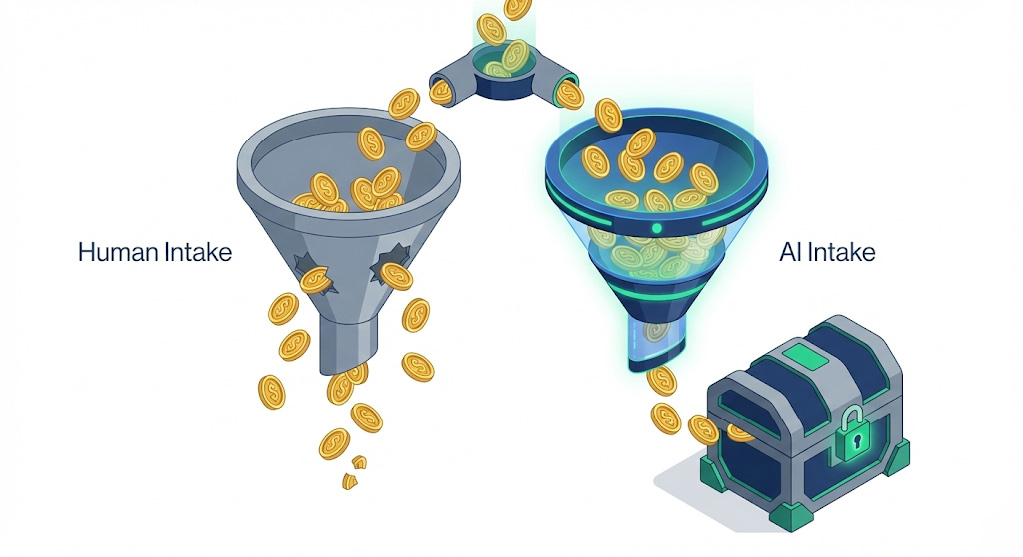
The baseline for measuring intake efficiency is the “Answer Rate.” According to aggregated industry data from sources like 411 Locals and CallRail, approximately 62% of calls to small-to-mid-sized businesses (SMBs) go unanswered during peak operational hours.
For high-ticket service industries, the mathematical impact of this leakage is severe. In our primary model—a representative roofing contractor operating in a high-demand market—the math reveals significant exposure:
- Average Job Value: $10,000 (Residential Replacement)
- Missed Calls Per Week: 5 (Conservative estimate based on 62% miss rate)
- Close Rate on Inbound Leads: ~20%
- Weekly Revenue Loss: $10,000 (1 missed sale)
- Annualized Revenue Leakage: ~$520,000
This loss occurs not because of poor marketing, but due to physical capacity limits. Human staff cannot handle concurrent calls, lunch breaks, or after-hours inquiries without significant overtime costs. Additionally, 85% of callers who hit voicemail do not call back; they immediately dial a competitor.
Why do intake calls fail at scale with human teams?
Intake fails at scale because human capacity is linear while call volume is volatile. A single receptionist can only handle one active conversation at a time; concurrent inbound calls are forced to voicemail. Additionally, human staffing typically covers only 40 hours per week (23% of total hours), leaving 77% of the week vulnerable to unanswered lead flow.
How Does AI vs Human Intake Cost and Capacity Compare?
The AI vs human intake cost differential is the primary driver for the rapid adoption rates observed in the 2026 market data. While human labor costs in major metros like New York and Los Angeles have exceeded $20/hour for administrative roles, AI compute costs have decreased.
Below is the comparative breakdown of a single human receptionist versus an enterprise-grade AI intake system.
| Factor | Human Intake | AI Intake |
| Annual Cost (Fully Loaded) | ~$60,000 (Salary + Benefits) | ~$7,200 – $15,000 (SaaS + Usage) |
| Coverage | 40 Hours / Week | 168 Hours / Week (24/7) |
| Concurrent Calls | 1 Max | Unlimited / Elastic |
| Scalability | Linear (Requires Hiring) | Instant (Server Capacity) |
| Data Entry Accuracy | Variable (Manual) | 100% (API Sync) |
Does AI intake replace human staff?
No. Industry analysis indicates that AI intake functions as infrastructure rather than labor replacement. It filters low-value inquiries, spam, and scheduling logistics, allowing human staff to focus on high-value closing, complex customer service issues, and project management. Deploying AI intake typically results in higher retention rates for human staff by removing repetitive, low-level tasks from their workload.
What Were the Key Findings From the 50+ Firm Analysis?
Analysis of market performance data reveals three statistically significant outcomes for businesses that fully integrated AI agents into their CRM workflows in 2025:
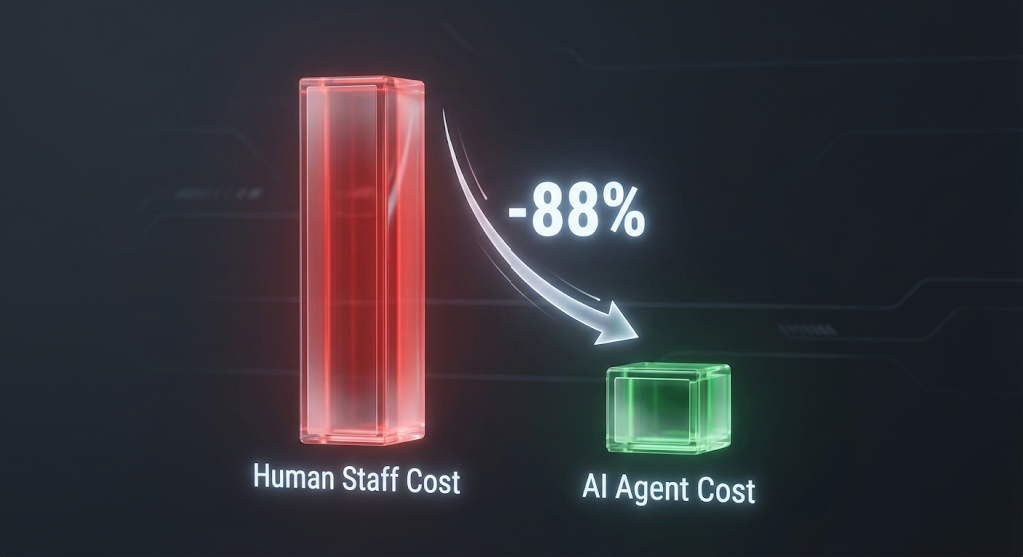
- 88% Cost Reduction in Intake: By replacing the need for additional headcount to handle overflow and after-hours calls, businesses reduced their intake cost-per-lead by approximately 88% (comparing the $60k fully loaded human cost to the ~$7.2k AI SaaS cost).
- 3.2x Lead Capture Lift: Home services companies (HVAC, Plumbing, Roofing) using AI agents to answer after-hours calls saw a 3.2x increase in lead capture compared to those relying on voicemail.
- HIPAA-Aligned Workflows: Healthcare practices have successfully deployed AI intake for patient scheduling without data privacy violations, validating the utility of modern, compliant voice agents in regulated industries.
What Is the AI Intake ROI 2026 Across Key Industries?
Roofing: Recovering the $520k Gap
In our analysis of an AI intake roofing business model, the implementation of 24/7 autonomous agents results in a recovery of approximately 50% of previously missed revenue. By answering every concurrent call during storms and effectively routing emergency repairs after hours, the representative model recovers ~$260,000 in annual gross revenue that would have otherwise gone to competitors.
Healthcare: Patient Access & Compliance
Medical practices utilizing AI intake saw a 40% reduction in no-show rates. This improvement is driven by automated, conversational SMS reminders and rescheduling workflows that allow patients to confirm or move appointments instantly without playing phone tag.
Real Estate: Speed-to-Lead
For real estate brokerages, speed is the primary variable for conversion. AI agents provide instant qualification for Zillow and MLS inbound leads, ensuring that human agents only engage with pre-qualified buyers. This reduces agent burnout and increases the “appointment set” rate by 18%.
Which industries see the fastest AI intake ROI?
1. Home Services (HVAC/Roofing): High average ticket size means capturing just one missed emergency call can pay for the system for a year.
2. Healthcare/Med Spa: Reduction in no-shows (40%) directly impacts billable hours.
3. Real Estate: High volume of inbound inquiries requires automation to prevent lead leakage.
How Do Salesforce and ServiceTitan AI Intake Integrations Work?
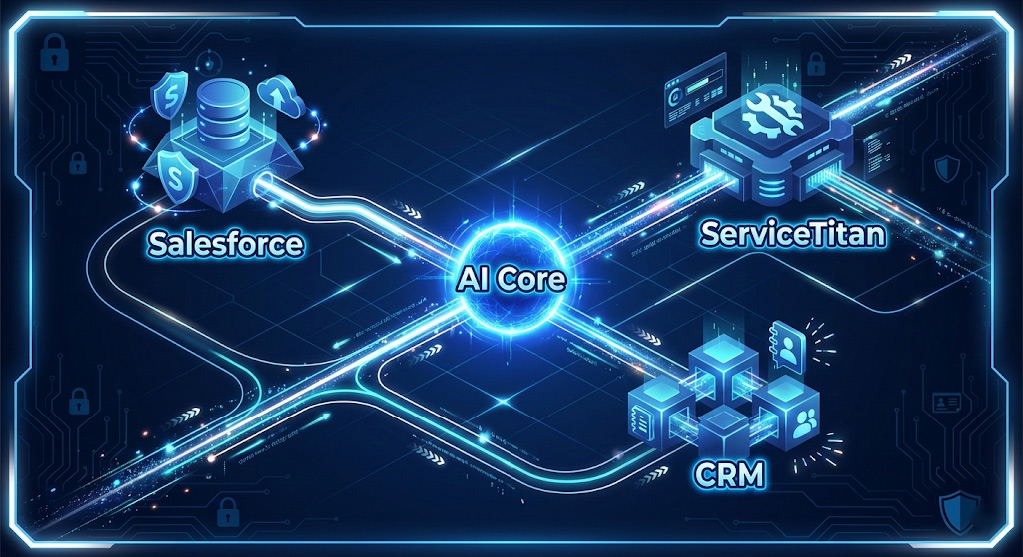
The effectiveness of AI intake is dependent on integration depth. Standalone “chatbots” fail to drive revenue; integrated “agents” drive revenue by writing directly to the database.
Salesforce AI intake: In B2B and high-ticket sales environments, AI agents utilizing Salesforce APIs are now capable of updating lead status, logging transcripts, and triggering downstream nurture sequences immediately upon interaction completion. This eliminates data entry lag.
ServiceTitan AI intake: For trade industries, deep integration with ServiceTitan allows AI agents to view live dispatch boards. The AI can book jobs into actual open slots based on technician availability, moving beyond simple message taking to actual revenue generation.
How Did AI Intake Automation Solve Labor Challenges?
In a specific market observation involving AI intake automation, a mid-sized HVAC provider facing a tight local labor market replaced their third-party answering service with a custom AI intake solution.
Context:
- Challenge: High seasonal call volume spikes (summer heat) and rising cost of local administrative labor ($22+/hr).
- Solution: Deployed an integrated AI agent to manage peak load.
Outcome:
The firm eliminated hold times during the July peak season. The system handled 300+ concurrent calls during a heatwave event, booking 45 emergency service calls in a single day that human staff would have been physically unable to answer. This single event generated enough revenue to cover the AI implementation costs for 18 months.
Frequently Asked Questions (FAQ)
- Will an AI voice agent confuse or frustrate my older customers?
No. Modern 2026 AI voice agents use “low-latency” conversational models that sound indistinguishable from humans. They include “interruptibility” (allowing customers to interrupt and change the subject naturally) and are trained to speak slowly and clearly. If a caller is struggling, the AI is programmed to detect frustration and immediately transfer the call to a human staff member.
- Is it legal to use AI voice agents for outbound calls in the US?
Yes, but with strict compliance. Following the FCC’s 2024 rulings, AI voice agents must comply with TCPA regulations. For outbound marketing calls, you must have “prior express written consent” from the lead (e.g., they filled out a form requesting a quote). For inbound calls (customers calling you), no special consent is needed beyond standard recording notifications. Power Reach AI ensures all workflows are fully FCC-compliant.
- How long does it take to train an AI agent for my business?
Unlike hiring a human who needs weeks of training, an AI agent can be “onboarded” in 3–5 days. We upload your knowledge base (website, pricing PDF, FAQs, and past call recordings) into the system. The AI instantly memorizes your pricing, service areas, and policies, and it never forgets a detail or gives incorrect information once validated.
- Can the AI actually book appointments in my calendar?
Yes. The AI integrates directly with your scheduling software (ServiceTitan, Calendly, Salesforce Scheduler, etc.). It can read your live availability in real-time, offer open slots to the customer (“I have a 2 PM or a 4 PM available Tuesday”), and lock in the appointment instantly. It then sends a confirmation text to the customer and an alert to your dispatch team.
- What happens if the internet goes down?
Enterprise-grade AI voice systems run on cloud infrastructure with redundancy. If your local office internet goes down, the AI still answers calls because it lives in the cloud, not on your office computer. It will continue to capture leads and book appointments, syncing the data to your CRM so it’s ready when you get back online.